LOADING
1950S–1970S
Color Field
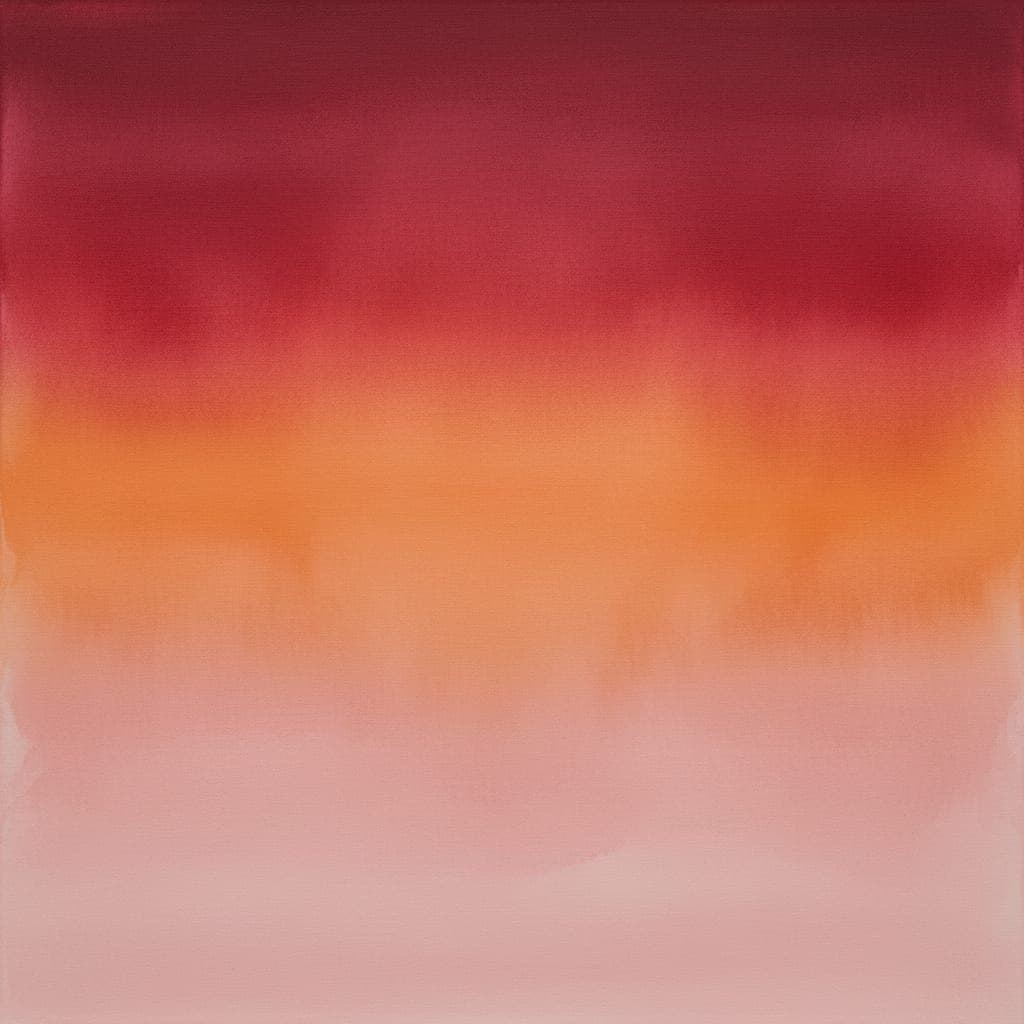
Large planes of color that envelop you. Color field painting stripped away gesture and narrative, leaving only the direct emotional impact of hue against hue at room-filling scale.
CREATE IN THIS STYLESAMPLE COMPOSITIONS
Six pieces in this style
Each piece below is ready to ship. Buy as is, or use Create variation for a tweak.


Color field painting emerged from abstract expressionism but rejected its drama. Where Pollock and de Kooning were all gesture, Mark Rothko and Helen Frankenthaler and Barnett Newman were stillness. They wanted color itself, at room-filling scale, to do all the emotional work.
The technique mattered. Frankenthaler thinned her oil paint and stained it directly into raw canvas, so the color became the canvas rather than sitting on top of it. Rothko built his paintings from many translucent layers, so the surface seemed to glow from within. The work rewarded slow looking. Stand in front of a Rothko for five minutes and the color starts to vibrate.
On a wall, color field painting is a meditation device. It needs space. It needs distance from competing visual elements. But given those, it transforms a room. The work doesn't depict anything. It just exists, holding its scale and color, and the room gathers around it.
When you generate in this style, our pipeline steers toward the conventions: large flat planes of color, soft feathered edges, minimal compositional elements, the sense of color staining into surface rather than sitting on top. The result is meditative, atmospheric, and at scale on your wall, transformative.
SIGNATURE PALETTE
#6A0DAD
#E74C3C
#4A90D9
#DAA520
#F4C2C2
VISUAL VOCABULARY
When you generate in this style, our system weighs these elements to keep the result authentic:
large flat planes of colorsoft feathered edges between color areasminimal composition, 2-4 color zonespalette: deep purple, cadmium red, cerulean blue, ochre, soft pinkcolor bleeding and soaking effectno defined shapes or objectsmeditative atmospheric qualitystained canvas texture
Ready to make your own?
Five free generations. No credit card. Tell us about your space.
START WITH COLOR FIELDRELATED AESTHETICS